


Main image by Dom Pates via Flickr.
My title is such B.S., just like the post by a website that rhymes loosely with “Bruce’s Feet” (I hope this doesn’t attract people with a foot fetish, although if your name is Bruce, welcome).
If you Google the “best soy sauce,” a shiesty post titled “The 8 Best Soy Sauces of 2020” pops up, and if you think I’m throwing shade for no reason, let me explain. The products listed on that site are not the “best” because saying something is the best is subjective, although they also do not cite what their criteria are in their evaluation, which may or may not be based on product quality (ingredients), taste, or price.
The other articles online have Chinese and Japanese brands all thrown together, but I will focus primarily on Japanese soy sauces, which have a very distinctive taste and style compared to Chinese soy sauces due to the natural brewing method.
Soy sauce was invented by the Chinese, and if you want to know the history from China to Japan, this Japanese site soysauce.or.jp has the history of soy sauce.
The products listed in other articles are chosen to merely promote their Amazon or Instacart affiliate links. So in my eyes, their content is completely useless in regards to being “the best” because they have a clear agenda which has nothing to do with finding you the best of anything. The article should be retitled to “the best way to put some money into our pockets sucka foo.”


The history of Soy Sauce
Beyond the Japanese website with their history of soy sauce from China to Japan, Samuel Wells Williams, and his book “the Middle Kingdom, published in 1848 (original by Harvard University), A Survey of the Geography, Government, Education, Social Life, Arts, Religion & of the Chinese Empire and Its Inhabitants ; with a New Map of the Empire · Volume 2” can be read free of charge via Google Books.


Japanese shoyu and all the major brands and the types
Keep in mind, asking “which is the best soy sauce” is like asking “which is the best beer.” So I have the 3 biggest and most popular Japanese soy sauce brands listed, along with the “craft” soy sauces at the bottom link/article.
I swear tho, most beer drinkers think an IPA is the end all, be all of beers tho.
You will be more than happy using any of the top three brands listed in this article (according to Kikkoman, there are 1,300 soy sauce producers and Kikkoman owns 30% of the domestic market) although if you want to try products from regional producers in Japan, you will want to try all the craft soy sauces.

The Inclusion of Wheat of Various Ratios in Japanese Shoyu Is What Makes It Distinctive From Other Soy Sauces
Japanese soy sauces are fermented and are comprised only of:
- Water
- Koji (Aspergillus oryzae)
- Soybeans (steamed and roasted)
- Crushed wheat (except for tamari which contains little to no wheat although the inclusion of various ratios of wheat gives Japanese soy sauces a nuanced flavor.)
- Salt
Compared to other non-Japanese soy sauces, Japanese shoyu is commonly non-GMO and does not contain corn syrups, artificial caramel, to hydrolyzed vegetable protein or hydrochloric acid.
Soy sauce aka shoyu (Japanese), jiang you (China), whe-ganjang (Korea)
I had to edit this blog post (1/10/23) because I ran across an article saying that Japanese shoyu was not the same as “soy sauce,” which is ridiculous. After all, it is a SAUCE MADE OF SOY, and as I read that, it reminded me why I do this blog (they were also Asian, and their Asian card needs to be revoked).
The article goes on to tout how Japanese shoyu is not the same as soy sauce which is perplexing because if it is not a “soy-based” sauce, what is it or it’s origins?
Yes, shoyu is a soy sauce, and you can use “shoyu” and “soy sauce” (like they do in the 808/Hawaii) interchangeably, although not all soy sauces are the same. They vary by country of origin to regional varieties (usukuchi to koikuchi for Japanese soy sauce).
In the United States, we have regional soy sauce from Hawaii by Aloha shoyu, which reflects the Japanese, Asian American, and multi-ethnic influence on the island. One blogger, she somehow thought, soy sauce and shoyu were two different things.
So let me say that an overwhelming amount of things from around the world came from China (chicken noodle soup, ketchup, alcohol, etc), but in Japan and Korea, they can thank the Chinese (I also thank the Chinese). So if you want to avoid such silly content, head on over to the Woks of Life where you can learn all about Chinese soy sauce called “jiàng yóu.”
So is it identical to Chinese soy sauce? No, but its roots are Chinese soy sauce, and “shoyu” is the Japanese name for soy sauce. The same goes for many other countries, like Korea, which have its own name for soy sauce (crazyKoreancooking.com knows all about it).
Well, I won’t dwell on this topic, and I think most understand that you can refer to most soy sauce “interchangeably,” although you can’t dismiss the distinct regional styles by producers from around the globe.

Japanese shoyu compared to soy sauces from around the world
If you did not grow up with soy sauce, you would lump all soy sauce together as the same or “Asian stuff,” as several media outlets have done.
You will not find most American media outlets lumping French, German, or Russian condiments together, but when it comes to Asian ingredients, many act as though they are all the same.
The ingredients for soy sauces vary greatly from China, Japan, to Korea. It is also what gives many Hawaiian dishes a distinctive taste regardless of Aloha Shoyu’s Japanese influences.
It is unfortunate because it dismisses the regional distinctiveness these ingredients provide regional dishes. So a Hawaiian-style soy sauce for Japanese dishes can dramatically change a dish’s taste.
These are the ingredients of the top soy sauce brands by country (and a US state a type/style of soy sauce, tamari)
| BRAND | ETHNIC TYPE | INGREDIENTS |
|---|---|---|
| Aloha Shoyu | Hawaiian | Water, wheat gluten, soy beans, salt, sugar, caramel coloring, sodium benzoate & potassium sorbate, a preservative. |
| Kikkoman | Japanese | Water, Soybeans, Wheat, Salt |
| La Choy | Chinese | Water, Hydrolyzed Soy Protein, Salt, Corn Syrup, Caramel Color, Potassium Sorbate (Preservative). |
| Lee Kum Kee | Chinese | Water, salt, soybean, sugar, wheat flour, sodium benzoate added as a preservative, Disodium 5-Inosinate & Disodium 5-Guanylate as flavor enhancers. |
| Pearl River Bridge | Chinese | Water, soya beans, sugar, salt, Contains: soy, wheat, sulfites. |
| San-J | Japanese | Water, Organic Soybeans, Salt, Organic Alcohol (to preserve freshness). |
| Sempio | Korean | Water, defatted soybean, wheat, salt, spirits, high-fructose corn syrup, yeast extract, licorice extract, sucralose. |
Tamari has little to no wheat and is one of the five types of Japanese soy sauces, but the most popular type is koikuchi (1:1 wheat and soybeans) with upwards of 80-90% of the market? Whereas tamari has only 1-2% of the market share in Japan.
Tamari is historically the Japanese version of Chinese soy sauce which was a way to stretch the highly prized resource, salt, for food preservation (yea, refrigerators weren’t a thing back in the day).


The 5 types of Japanese Soy Sauces
A condiment that has been produced in Japan for upwards of 1,000 years.
The defining characteristic of Japanese soy sauce is the inclusion of wheat, and the types are defined by the ratio of soybean to wheat and the brewing method: 1. Koikuchi (most popular, ~80% of the market), 2. Usukuchi (2nd most popular, ~14%), 3. Tamari (originally a byproduct of soybean miso, ~2%), 4. Saishikomi (double-brewed, ~1%), and 5. Shiro (mostly wheat soy sauce, <1%).
I personally use usukuchi the most, which is a regional favorite in the Kansai region (Kyoto/Osaka).
Like condiments in the US, soy sauce is also regional and use/dish specific.
| TYPE | MY BROAD GENERALIZATION | PRODUCT DESCRIPTION |
|---|---|---|
| Koikuchi General purpose soy sauce (strong flavored) | What you find on most shelves, restaurants (like sushi bars), etc. If you had soy sauce, you had koikuchi. It is also the Kanto (Tokyo) region style soy sauce. | The most popular/common (upwards of 80%) soy sauce which consists of 1:1 of soybeans and wheat. |
| Koikuchi genen shoyu Low-sodium | A low-sodium soy sauce, which Japan has an issue with hypertension, and Muricans love to drown our food in soy sauce. So, it’s good for any country wanting to watch their salt intake. | 20-40% less salt. |
| Koikuchi, marudaizu Whole bean | Whole bean for a vs. diced and chopped soy beans. I have purchased various brands, and I seriously do not think I can differentiate from a standard koikuchi (I thought I had somewhat discerning taste buds). | Uses whole soybeans and takes longer to ferment so it is generally more expensive. |
| Usukuchi Lighter colored and saltier | Lighter colored, saltier, and my favorite for cooking. I prefer it in dashi (soup-based dishes) and most dishes, except NOT for sashimi or sushi. | Lighter colored but utilizes more salt than koikuchi (so quit buying it and rating the product low because of a misassumption of the product being low sodium soy sauce, I am talking to you Amazon buyers/review section). |
| Shiro “white” | I have a massively sized bottle which is collecting dust, and I only bought it to experiment with (this is every Murican who touts to be gluten-free, their arch nemesis). | Primarily composed of wheat with very little soybeans. |
| Saishikomi Double brewed | Double brewed for a deep intense flavor and great for sushi, sashimi, yakitori, yakiniku, or unagi. | A stronger and deeper flavored soy sauce great for dipping. |
| Tamari Typically gluten-free | This is the soy sauce for you, if you are an American because removing or eating one ingredient, gluten, somehow makes you healthier. Except, it’s also good for sushi/sashimi. This is the least popular in Japan with only a 1-2%. consumption rate. | Mostly to all soybeans and is based on the Chinese product (a by-product of hatcho miso production) that introduced Japan to soy sauce. |

Three Major Japanese Shoyu Brands
Japan ranks #1 in the world for the most multigenerational businesses, some over 1,000 years old.
The largest and most dominant Japanese brands are:
Kikkoman is the largest soy sauce producer in the world.
1. Kikkoman with 2. Yamasa and then 3. Marukin.


KIKKOMAN
“The Kikkoman/shoyu plant is the highest producing facility in the world is located in Walworth, Wisconsin.“
– If you want to read more, check out the article on the Shepherd Express
Founded:
Kikkoman was founded on December 7th, 1917 and is based in Noda, Chiba Prefecture, Japan. The company itself is comprised of eight family-owned businesses which were founded as early as 1603 by the Mogi and Takanashi families.
About Kikkoman:
Kikkoman is the most popular brand of soy sauce in Japan and the United States and is the largest shoyu manufacturing company in the world which is also the company responsible for introducing shoyu to the West.

Kikkoman, the #1 Soy Sauce Brand
| TYPE OF SOY SAUCE | PRICE/ VENDOR |
|---|---|
| Kikkoman Koikuchi Tin/128 oz | $51.32 Amazon |
| Kikkoman Koikuchi 1 Gallon | $18.53 Amazon |
| Kikkoman Japan Made Soy Sauce 33.8 fl oz | $8.00 Amazon |
| Kikkoman Smooth Aromatic Soy Sauce 6.8 fl oz | $3.58 Amazon |
| Kikkoman Usukuchi Soy Sauce 33.8 fl oz | $8.31 Midoriya NYC |

YAMASA
“Soy sauce manufacturers use different kinds of Koji mold, and we use a unique strain of mold called YAMASA Aspergillus that we have nurtured over hundreds of years, since the Edo era.”
– Yamasa
Founded:
Yamasa was founded in 1645 and the head office is located in Choshi, Chiba, Japan.
In their words about their products:
“we insist on making our products through traditional methods. Our soy sauce has a delectably rich flavor with a crisp, spicy aroma and brilliant red color. The preferred brand selected by many of Japan’s finest restaurants, YAMASA produces a slow-brewed soy sauce that is fermented and free of all artificial flavorings.” – Yamasa

Yamasa, the 2nd Largest Soy Sauce Brand
| TYPE OF SOY SAUCE | PRICE/ VENDOR |
|---|---|
| Yamasa Japan Koikuchi Imported 34 fl oz | $28.99 Amazon (2 pack) |
| Yamasa Organic Marudaizu Soy Sauce 34 fl oz | $18.99 Amazon (1 item) $24.99 Amazon (2 pack) |
| Yamasa Usukuchi Soy Sauce 34 fl oz | $6.20 MTC Kitchen |

MARUKIN
“The Shodo Island production brewery includes a natural fermentation “cellar” dating back to the early 1900’s where the soy sauce is produced in approximately 300 wooden barrels made of Japanese Cedar. This facility-one of Japan’s largest natural breweries-has a production capacity that comprises around 30% of the naturally brewed soy sauce made in wooden barrels in Japan.”
– Marukin
Founded:
Soy sauce manufacturing came to the Shodo islands around the 1600’s, but the Marukin brand was established in 1907.
In the words of Marukin about their products:
“Marukin enjoys a sterling reputation as one of the top five soy sauce brands in Japan. Along with its namesake soy sauce Marukin offers a range of soy-related seasonings as well. It is based on Shodo Island, among Japan’s top four soy sauce production areas. In testimony to its high profile and popularity throughout Japan, Marukin is beloved across the country for its delicious flavor and high quality.” – Moritakk
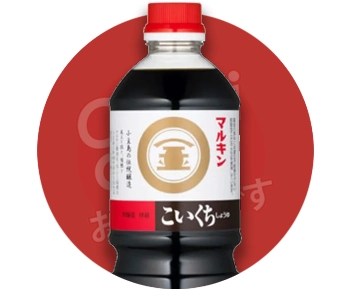
Marukin, the 3rd Largest Soy Sauce Brand
| TYPE OF SOY SAUCE | PRICE/ VENDOR |
|---|---|
| Marukin Dark Koikuchi Soy Sauce 1 LTR | $10.00 SakeInn |
| Marukin Premium Koikuchi Soy Sauce 6.66 fl oz | $9.90 Japanese Taste |
Americans often seek out tamari soy sauce because it is gluten-free, yet the U.S. does not come close to Japan in rankings for high life expectancy or low obesity rates. Japan consistently ranks among the top three countries in both categories.
In the US, buzzwords, superfoods, and excluding an ingredient don’t seem to be working or catching on for the general populace. You can read the stats and sources here “is Japanese food healthy.”


There are a number of small to artisanal producers in Japan (this is like craft beer vs. commercial beer)
Beyond the major soy sauce breweries, there are supposedly over 1,300 soy sauce/shoyu producers in japan.

If you are willing to pay $$$, this is the list for the best artisanal and craft soy sauces and where you can buy it from.
Or if you want a Japanese American creation, I have all the OG teriyaki sauces from the Japanese and Japanese American Community right here.
Just a few of the companies are (think of these like your craft beer companies): Choko, Daitoku, Fujikin, Inoue, Kishibori, Marunaka, Marushima, Mitsuboshi, Suehiro, Yamashin, Yugeta.

If you want to learn more, this dude has an interesting read (a lot of you click on the link)
I am more than happy to promote others and one such individual is Tom Schiller who has an in-depth blog article on shoyu, and I highly suggest you check out his blog OishisoJapan.com.

Of all those brands, I’ve only tried Kikoman. It’s so popular in Vietnam that nearly every Japanese restaurant uses it 🙂 What is your personal favourite?
There is one from the Ehime prefecture that I really love as a dipping shoyu although I do not know any other specifics. It makes me hungry thinking about it.
We are confirmed Yamasa users except for the specialty sauces, where we rely upon Aloha, in particular the Barbecue Sauce (which can be used in simple stirfry like Hawaiian style chop suey or chop steak) and the Teriyaki marinade.